- Flash UI sends HTMLish content to PHP script
- [x] PHP script writes HTMLish content to temp-file-A and calls a shell script
- [xx] Shell script runs an XSLT transform to convert HTMLish content in temp-file-A to temp-file-B
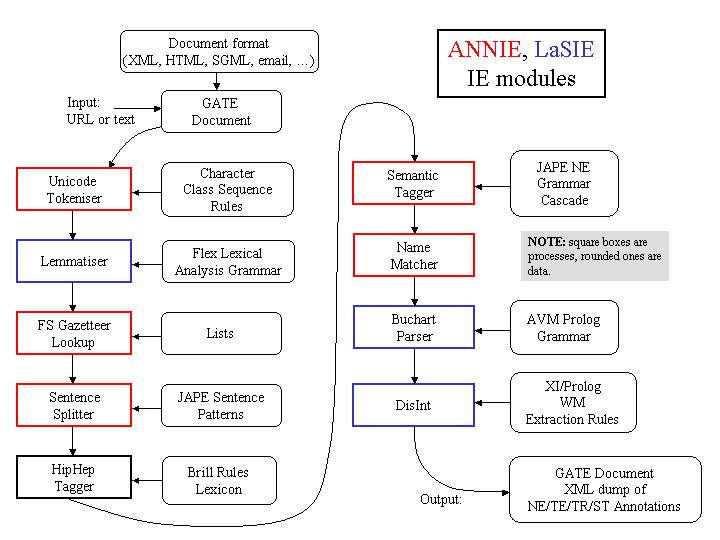
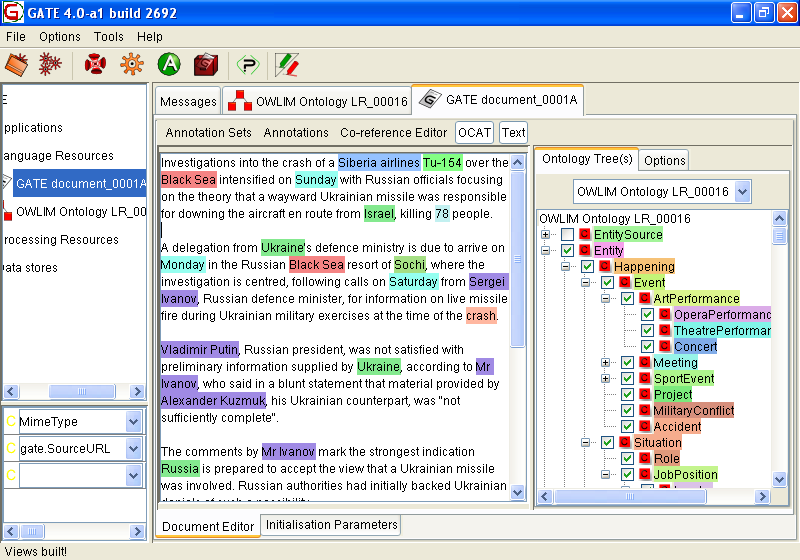
- [xx] Shell script calls a trivial Java program (calls ANNIE via GATE API) on temp-file-B
- [xxx] Java program outputs something that looks like XML (you have to wrap it in a tag or so)
- [xx] Shell script runs an XSLT transform on the GATE XML to get HTML-subset (temp-file-C)
- [xx] Shell script runs an XSLT transform on the GATE XML to get ad-hoc XML (temp-file-D) for unmarshalling into list of 5-tuples
- [x] PHP script reads temp-file-C and temp-file-D (thank you SimpleXML for the latter)
- [x] PHP saves HTMLish content and 5-tuples to MySQL database
- [x] PHP marshals HTMLish + tuples on output
- Flash UI displays new HTMLish and uses tuples for various clicky-clicky-bits
Like I how I give way too much detail to make something look harder than it really is? This thing I did was very very very easy and stupid.
It just involved me (as a grumpy Haskeller) picking up a lot of new minor skills, for example, teaching a button in Flash to only display if a static debugMode bool is set (hint: Bindable), or writing my very first SQL query (in PHP even):
function queryInsertAnnotation($doc_id,$annotation) {
return sprintf("INSERT INTO hst_annotations(doc_id, name, color, entity, comment) VALUES(%s,'%s','%s','%s','%s')",
  mysql_real_escape_string($doc_id),
  mysql_real_escape_string($annotation->name),
  mysql_real_escape_string($annotation->color),
  mysql_real_escape_string($annotation->entity),
  mysql_real_escape_string($annotation->comment));
}
As for the vexing question of how to preserve pre-existing annotations and paragraph boundaries when automatically annotating the text, we decided to punt. Just get something working first for traction. Made it real easy...